
Trading Symbol Confusion: Prefixes, Suffixes and Translation Issues Explained
Discover why trading symbols often cause confusion due to prefixes, suffixes and translation differences, and how to correctly interpret them to avoid trading mistakes.
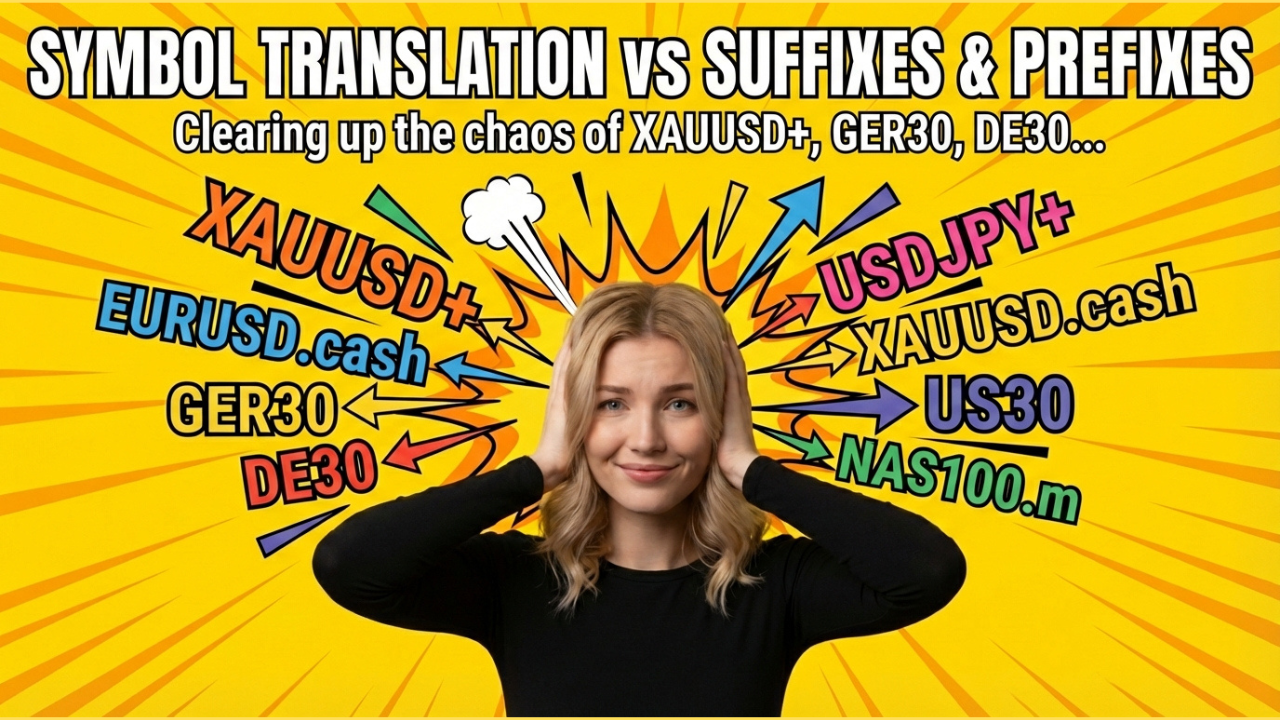
When copying trades between different brokers or platforms, many traders encounter significant hurdles in managing symbols correctly. Misunderstanding how symbols are named can lead to execution errors and lost opportunities.
In this guide, we will break down the mechanics of prefixes, suffixes, and symbol translation, providing you with a clear framework to ensure your signals always reach their destination accurately.
The Common Challenge: Prefixes and Suffixes
The most frequent issue in Forex, indices, and commodities trading is the variation in symbol naming conventions. A common scenario is when a Provider sends a signal for XAUUSD+, but the Copyer's broker only supports the standard XAUUSD.
"The golden rule of trade copying: signals should always travel in their canonical form."
To avoid confusion, the signal must be stripped of its unique broker-specific markings before being transmitted. This ensures that the receiver understands exactly what asset is being traded, regardless of their own broker's naming quirks.
How to Manage the Workflow:
- The Provider (Master): If your symbol has a suffix like
+, you must map it back toXAUUSDbefore sending the signal. - The Copyer (Receiver): The receiver is responsible for adding any necessary prefixes or suffixes required by their specific broker.
Practical Mapping Examples:
- Provider sends:
XAUUSD(Canonical) - Copyer 1 (Standard): Executes on
XAUUSD(No mapping needed) - Copyer 2 (Cash Account): Maps
XAUUSDtoXAUUSD.cashby adding a.cashsuffix. - Copyer 3 (Pro Account): Maps
XAUUSDtoproXAUUSD.mby adding aproprefix and a.msuffix.
Symbol Translation: When Names Change Completely
Translation is a different beast altogether. It is used when a broker changes the literal name of an asset, such as switching from GER30 to DE30.
In this case, only the Copyer needs to apply the translation. The Provider should continue sending the standard symbol.
"Translation is required when the underlying asset is the same, but the identifier is fundamentally different."
Translation Setup Example:
- Provider sends:
XAUUSD - Copyer's Broker uses:
GOLD - Configuration: The Copyer sets the translation parameter as
XAUUSD:GOLD. This tells the system: "When you receive a signal forXAUUSD, execute it onGOLD."
Handling Complex Scenarios
Sometimes, you might face a situation where both sides have unique naming conventions, which can be daunting. Let's look at a real-world example:
- Provider's Platform: Uses
_XAUUSD.m - Copyer 1's Platform: Uses
cashXauUsd.pro - Copyer 2's Platform: Uses
Gold.pro
The Solution:
- The Provider: Sets prefix to
_and suffix to.m. The signal is sent as the canonicalXAUUSD. - Copyer 1: Receives
XAUUSD. Sets prefix tocashand suffix to.pro. Additionally, they must use a translationXAUUSD:XauUsdto handle the case-sensitivity (sinceXAUUSDandXauUsdare treated as different identifiers). - Copyer 2: Receives
XAUUSD. Sets suffix to.proand applies the translationXAUUSD:Gold.
Why This Logic Is Superior
By centering the entire ecosystem around canonical symbols, you ensure maximum compatibility. Regardless of how many different brokers or services are involved in the chain, everyone knows they are dealing with the standard asset identifier.
This approach keeps your trading setup organized, scalable, and—most importantly—less prone to the manual errors that often plague cross-broker trade copying.
Are you struggling with symbol mapping or complex broker setups? Join the Copiix community on Telegram and get expert advice from our technical team!